
AI at all costs? Understanding pricing models
A unique opportunity for publishers
Before turning to the subject of pricing models for AI integration, let us take a quick look back at recent events.
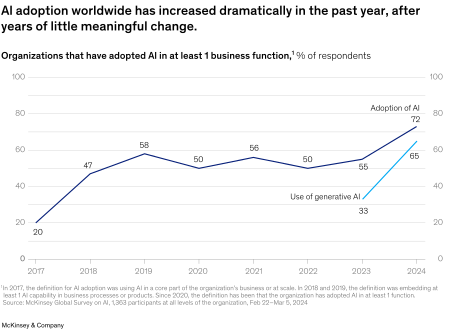
November 30, 2022: opening of ChatGPT, the first generative AI service for the general public. The event had an extraordinary impact. With over 100 million users in just a few weeks, it was the fastest adoption of a new technology in history.
The reason is simple: the simplicity of using our everyday language. No training to undergo, no certification to pass, no documentation to pore over. You ask a question, you get the answer. It is magic.
Use quickly spread to the business world. As is often the case, the novelty was banned, then used on the sly and finally gradually accepted by companies, willingly or not.
Rapidly evolving AI technologies
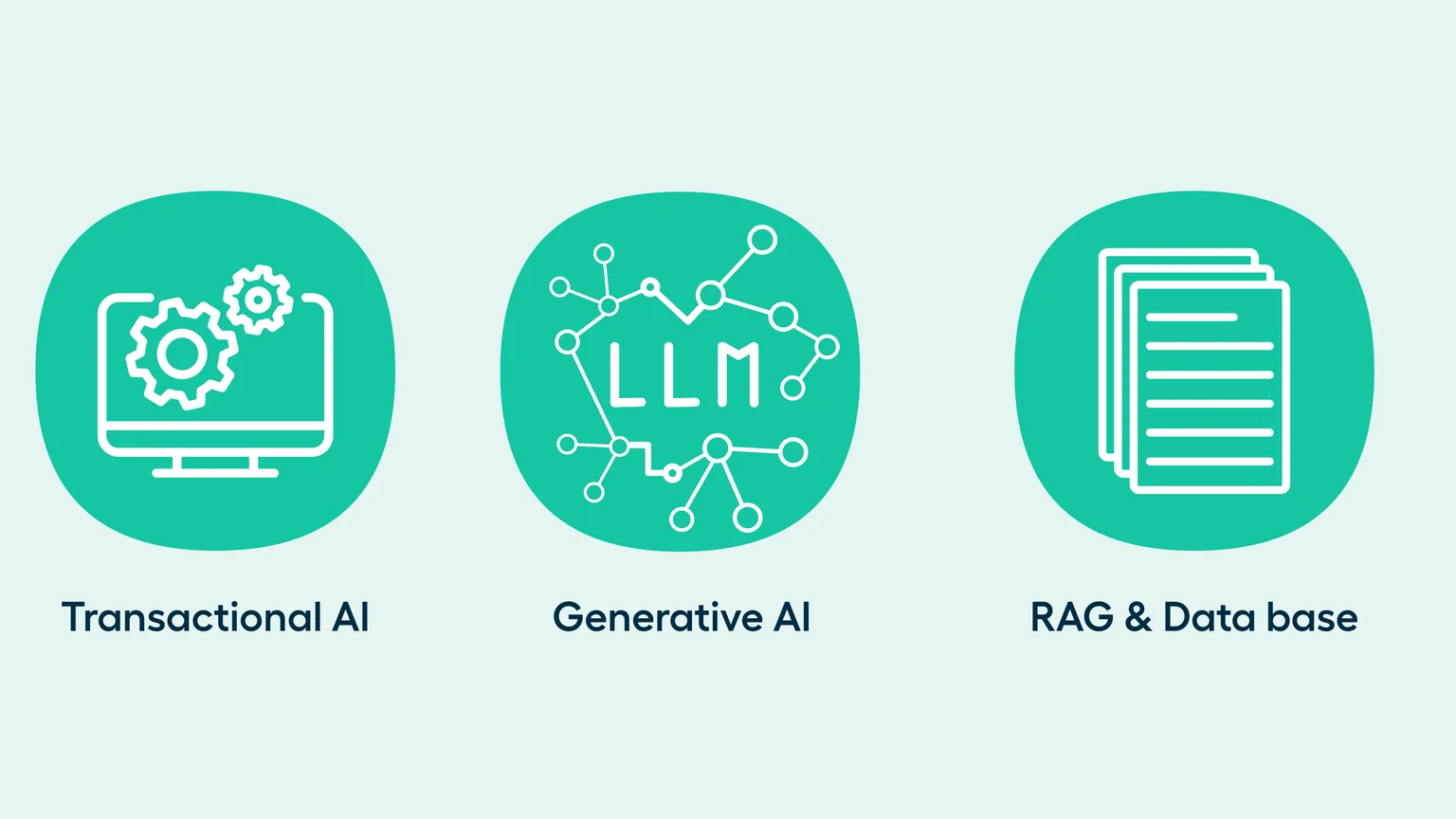
Over the past two years, technologies have been refined. Very quickly, new players and new uses have appeared: transactional AI, enabling direct action on applications, natural language querying of knowledge bases, and so on.
So it is only natural that users of business applications should expect their professional digital tools to take advantage of these new possibilities.
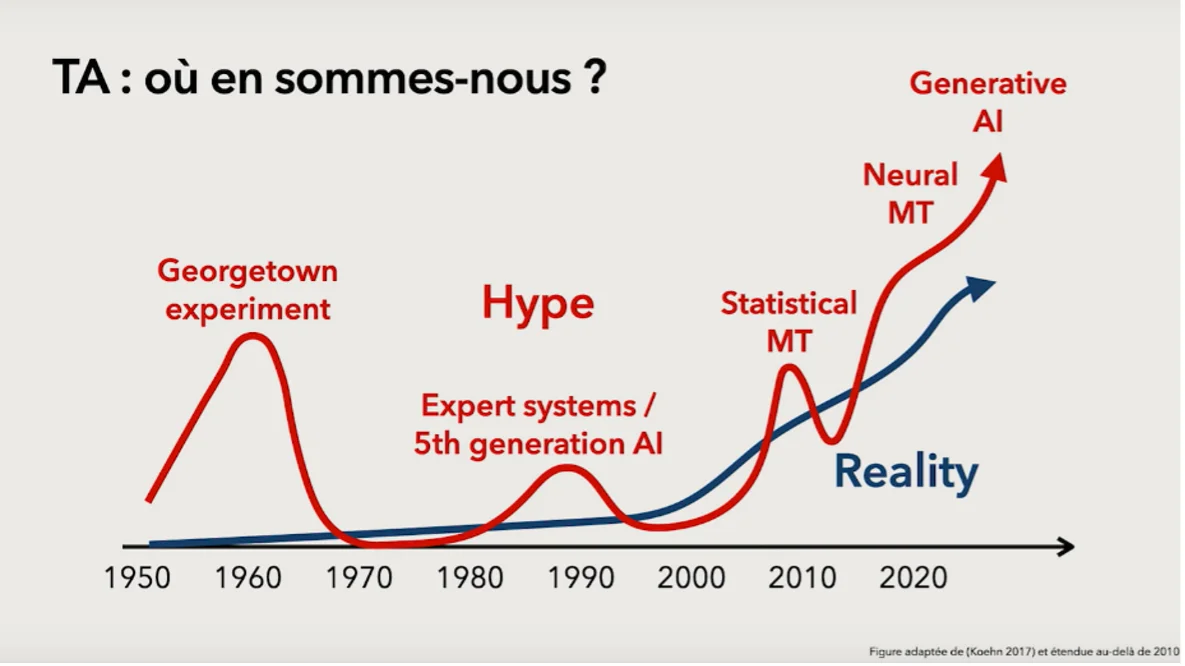
Let us take a step aside and look at the impact of technology on machine translation.
We can see that these solutions have undergone considerable change over the years. And that the recent arrival of large-scale language models (generative AI) has improved the quality of services to such an extent that their adoption has exploded, for those who have been able to take the plunge.
It is hard for software publishers to ignore this trend. It is even impossible not to analyze how to incorporate these innovative functions, which are so popular with users, into their solutions.
- Refine usage (“what is it for?”),
- Find the right partners,
- Involve their own technical and sales teams.
- And above all, identify opportunities to add value to their solutions.
Dust under the carpet?
However, AI is not immune to its limitations and problems.
In its recent study “2024 State of Generative AI in Global Enterprises”, Lucidworks issues five warnings:
- The fad is fading and companies are grounding their projects in reality. As a result, project planning is more considered.
- Delays in deploying AI projects diminish the expected return on investment: half of executives say they derive little benefit from generative AI.
- High implementation costs are leading companies to re-evaluate the expenditure allocated to these projects.
- It is the practical aspects that are driving the adoption of generative AI. In fact, governance and cost reduction are the main drivers of generative AI.
- Executives are investing in future-proof AI initiatives. Clearly, an LLM alone is not a generative AI solution capable of delivering results.
Furthermore, generative AI solutions have a number of shortcomings inherent in large language models (LLMs) that need to be seriously considered in the case of a professional implementation: hallucinations, security, trust and so on.
Before implementing AI technologies within their solutions, publishers therefore need to accurately analyze their customers’ needs, as well as their own strengths and weaknesses around this still shifting theme.
A competitive situation in upheaval
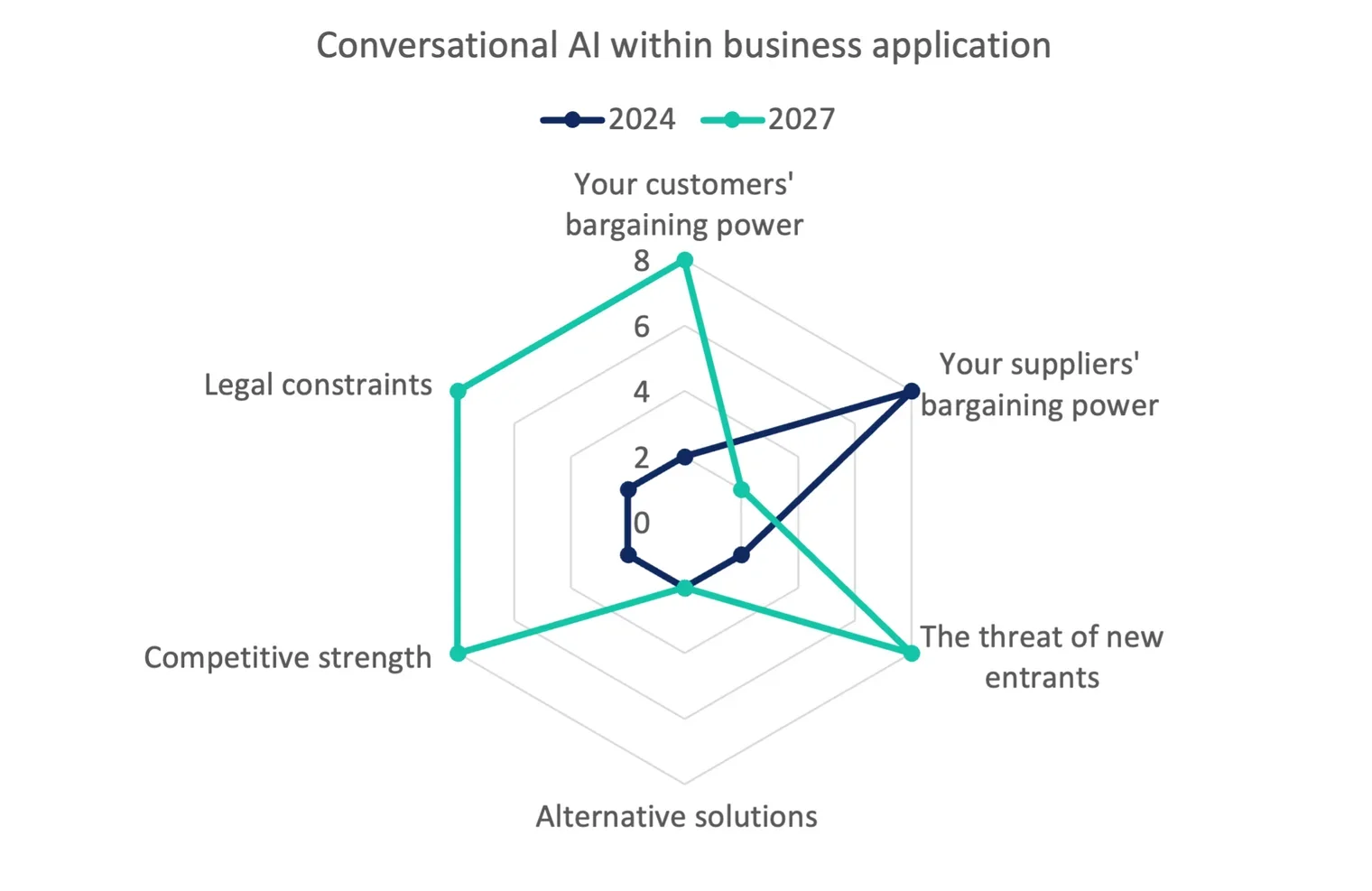
The arrival of conversational AI on the business applications market is reshuffling the deck, and the forces at play are undergoing profound transformations.
We recently devoted a full article to this subject, the conclusions of which we will be recapitulating directly here, with an indication of developments between now and a horizon of (at most) 3 years ahead:
- Your customers’ bargaining power will increase.
- Your suppliers’ bargaining power will decrease.
- The threat from new entrants is set to increase.
- No alternatives in sight.
- Your market’s competitive intensity will intensify.
- Legal constraints to be applied more rigorously.
The transformations are both profound and rapid, a sign that the time is right for publishers to adopt this theme with reason and determination.
Does AI cost an arm and a leg?
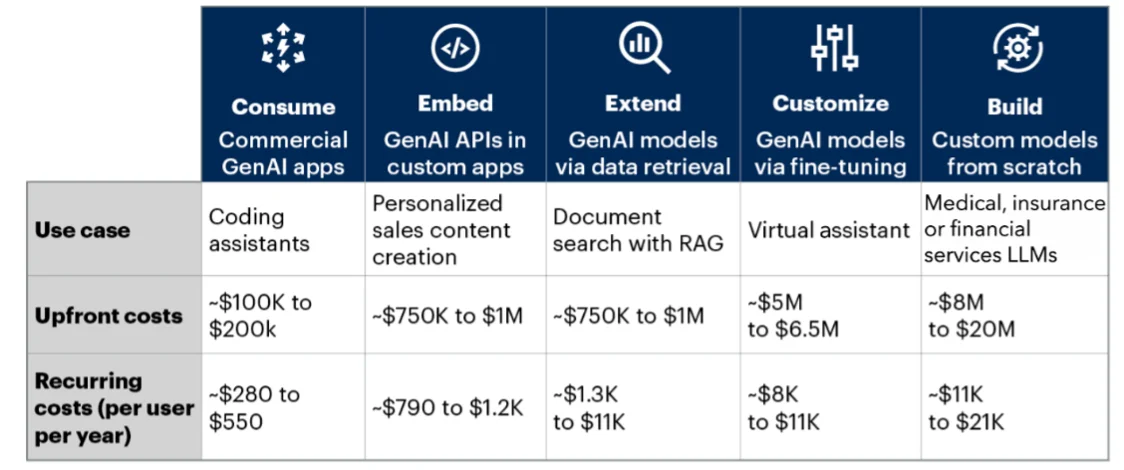
As a matter of fact, it does. Even both arms and both legs. Particularly generative AI, which draws its strength from the gigantism of the models and the infrastructure used to train them. According to Epoch AI, the training cost of frontier models has grown roughly 2.4x per year since 2016, and the largest training runs are expected to exceed a billion dollars as early as 2027.
This spending pace is bound to shake up the business models of the few companies capable of investing such sums, in the hope that “the winner takes it all” (GAFAM, NVIDIA).
For end-user companies, the costs are also considerable, depending on the uses, technologies and R&D to be invested. And in any case, they are out of reach for VSEs, SMEs and even most mid-size companies.
Is generative AI on the brink of collapse? We do not believe so for a second. After all, the Internet withstood the excesses and bubble of 2001 rather well, because its usefulness had already been demonstrated.
AI pricing models mean cost models. Naturally, we will have to come up with ways of escaping the curse of gigantism (some of which are already in place):
- The availability of smaller language models (still around 10 billion parameters) reduces the cost of training and inference;
- Open source, a topic we have already covered;
- The reasoned use of costly functions, obtained by mixing different technologies and getting the best out of each of them;
- The arrival of multi-tenant solutions (e.g. Agora Software), enabling technological and know-how costs to be shared between numerous customers;
- And of course, the integration of conversational AI within business applications, which brings benefits to businesses at marginal cost.
The arrival of the various European regulations has not finished spilling ink and creating heated polemics. But the General Data Protection Regulation (GDPR) has applied since 2018. The Digital Markets Regulation (DMA) and the Digital Services Regulation (DSA) since 2023. And the AI Act has been passed and will apply from 2025 for the most part. In short, we are going to have to learn to live with this legislative arsenal.
AI at the service of the application value chain
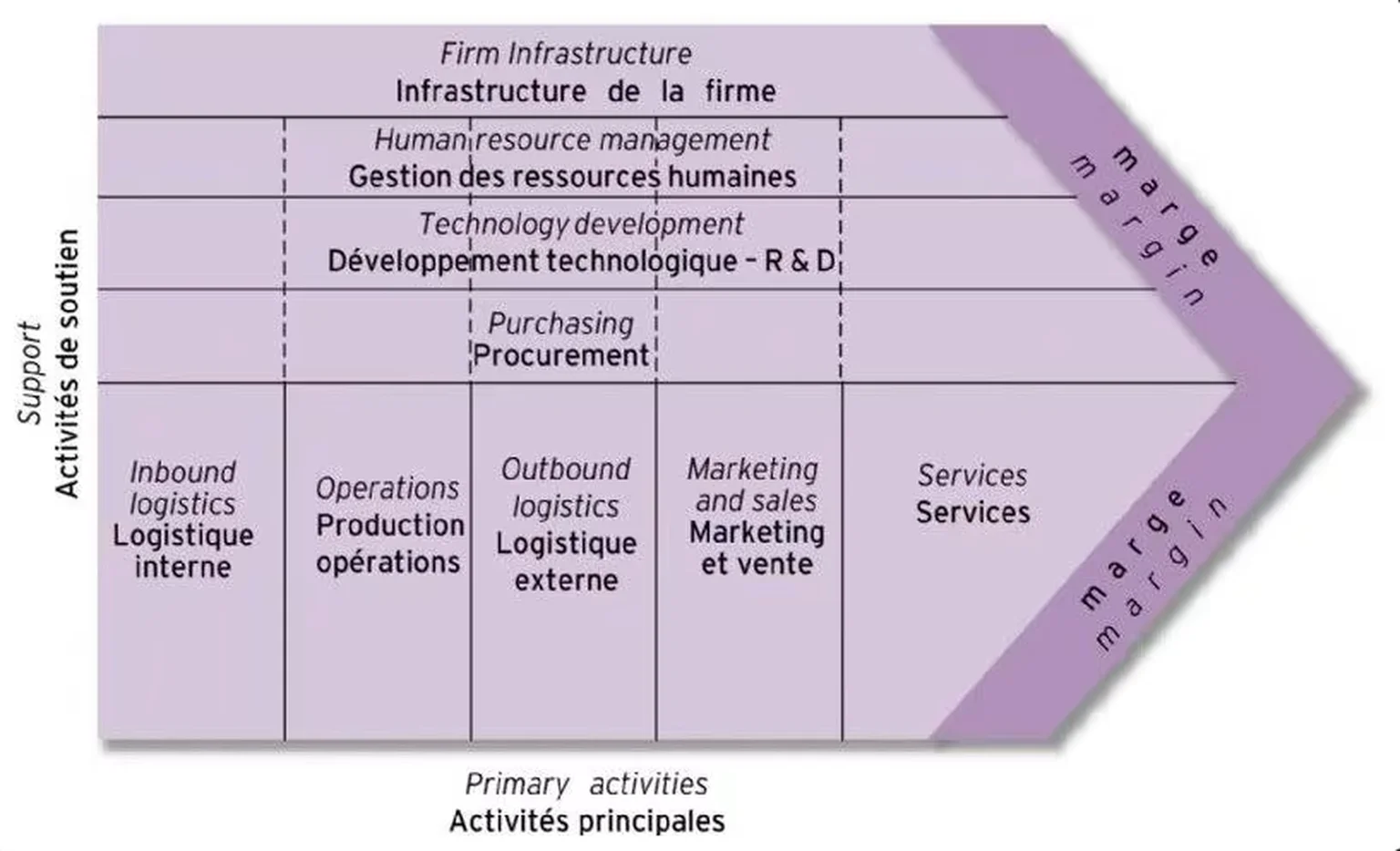
The value of a solution lies in its in-depth knowledge of the business and the quality of the implementation it offers its customers.
Applications such as ERP, HRIS, ATS, etc. provide tremendous support to many professionals in the performance of their missions.
Just as a software publisher does not design its servers, operating systems and databases, a software publisher does not set out to become an AI provider. Rather, they use AI to support their solutions.
This will not prevent them from becoming a specialist in the use of these technologies in the context of their business. Because that is where the value for their customers lies:
- Radical simplification of the user experience;
- Less time wasted in menus (“a sentence is worth 9 clicks, at least”);
- Less training, less documentation to read;
- Interrogation of business knowledge bases;
- Assisted drafting of recurring documents (quotes, invoices, etc.).
In an ATS, for example, a recruiter can ask “which candidates in the pipeline match the senior Java developer profile and were only rejected over salary expectations” instead of manually cross-referencing several filters and columns. Nine clicks fewer, one immediate answer.
Fad? After all, the software industry too needs fads to thrive. Provided we respond appropriately to the above warnings, user reaction to the arrival of ChatGPT seems clear enough to take a stand.
Finally, “not being in” would also imply hidden costs. Indeed, a publisher not integrating AI would necessarily pay the price in terms of image, unpreparedness for future transformations and technical debt.
Which pricing models for AI?
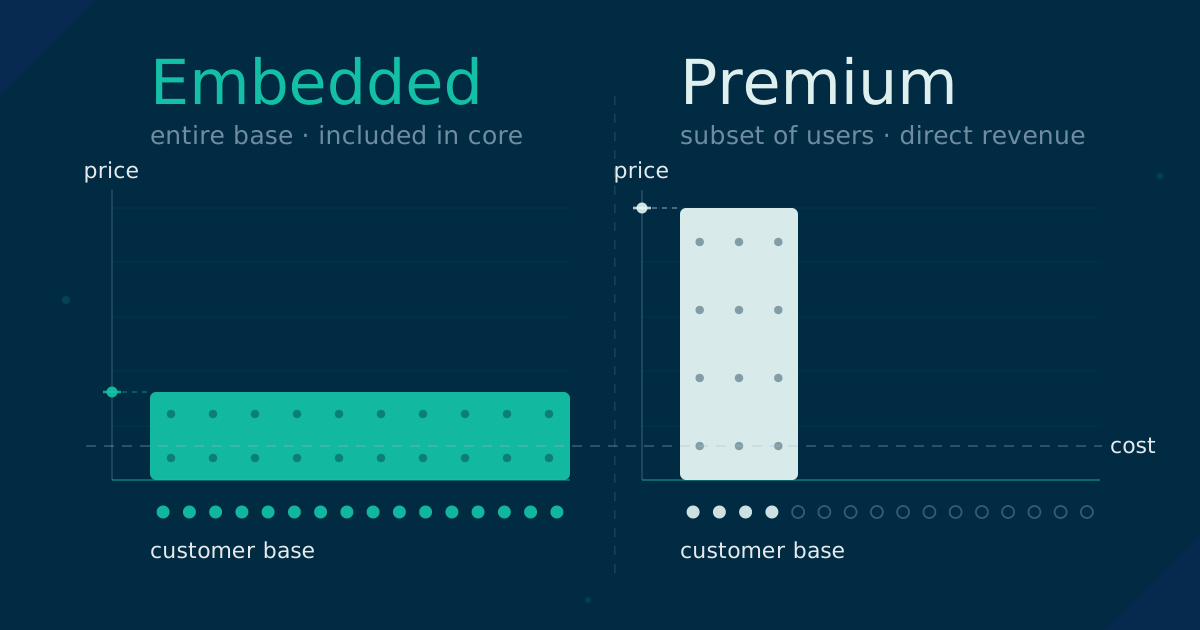
The truth is, the pricing model at which a publisher markets its conversational AI offering depends on the priorities it sets for itself:
-
Embedded — The aim here is to position the solution on an innovative axis, in tune with customer needs. In this case, AI becomes a fully integrated function within the product. As a result, distribution must be global and rapid across the entire customer base. The gains will be indirect but significant:
- Global price of business solution maintained (or even increased);
- Simplified sales through integration into the basic package;
- Aggressive and determined competitive positioning.
-
Premium — In this case, you are primarily looking for additional income. To do this, you need a price that is high enough to make it worthwhile, even if it means deploying only on a limited basis:
- Premium offer for a subset of users (or customers);
- Specific marketing and sales efforts;
- Search for immediate profitability.
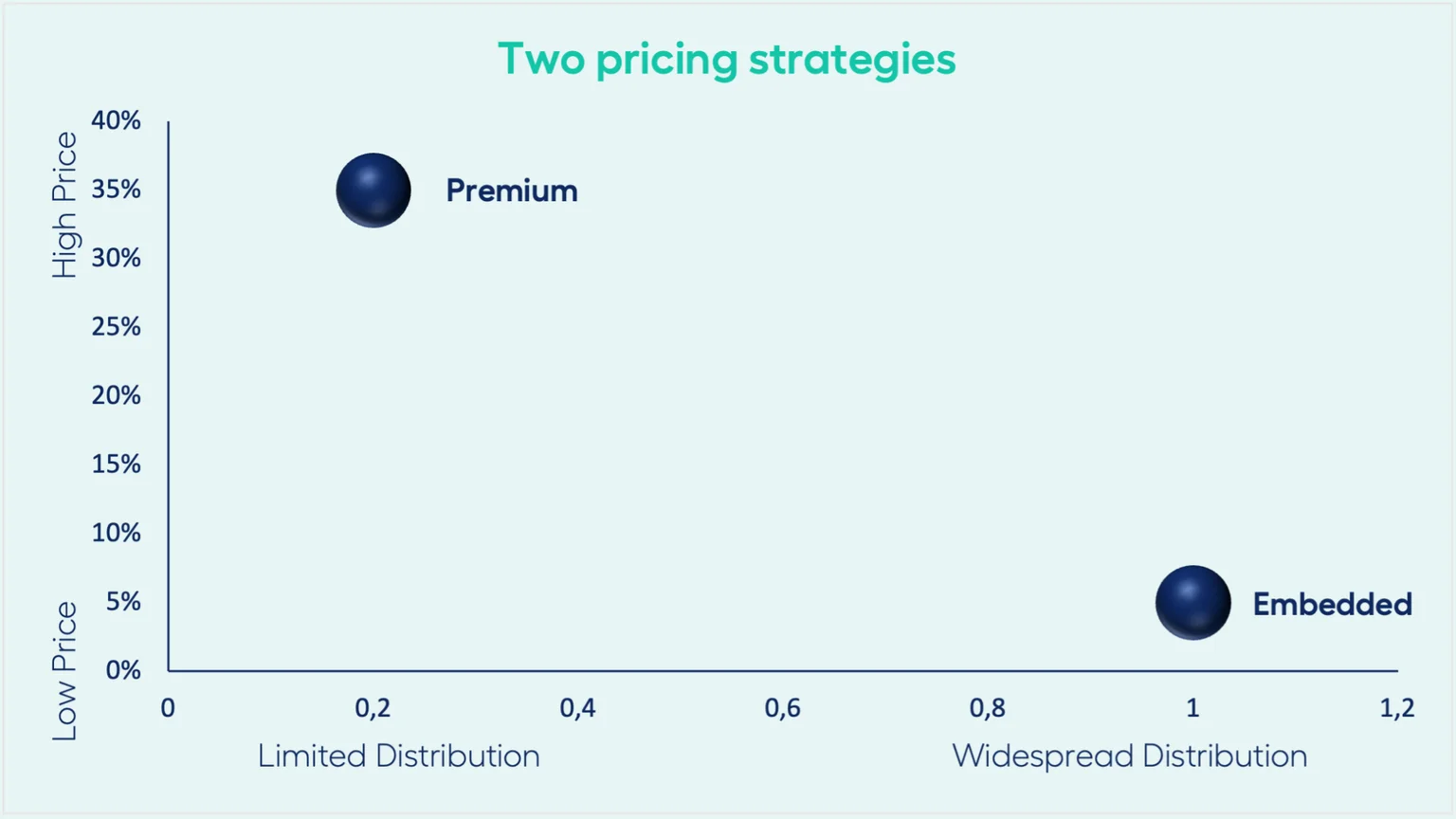
When considering AI pricing models, software publishers should take into account factors such as scalability, flexibility, and the specific features included in each pricing tier.
Key takeaways
- Adoption is real and fast: from 20% in 2017 to 72% of organizations in 2024, per McKinsey, driven by the simplicity of natural language.
- But half of the executives surveyed by Lucidworks admit they get little concrete benefit from generative AI: the bottleneck is no longer access to the technology, it is professional implementation.
- Frontier model training costs are growing roughly 2.4x per year according to Epoch AI, with the first billion-dollar training run expected as early as 2027: it is not up to publishers to carry that cost, but to pick the pricing model that turns this compute race into a product advantage.
- That choice, embedded or premium, says who you are with regard to AI: must-have or nice-to-have.
The pricing model you choose reflects your vision of AI within your product. Choosing the right language model -- open source, open weight or proprietary -- is just as strategic for controlling your costs.
Bring AI into your software with Agora Software.
Let's talk