
The AI Act: dura lex, sed lex
What is the AI Act?
The AI Act is a European regulation classifying AI systems according to their risk level. Its objective: “to guarantee safety, transparency and respect for fundamental rights.”
The AI Act defines an AI system as an automated system capable of adaptability that generates “predictions, content, recommendations or decisions”.
Application timeline
| Date | Milestone |
|---|---|
| 12 July 2024 | Entry into force |
| 2 February 2025 | Bans on unacceptable-risk systems |
| 2 August 2025 | GPAI model obligations |
| 2 August 2026 | General application of the regulation |
| 2 August 2027 | Rules for high-risk systems |
Risk classification
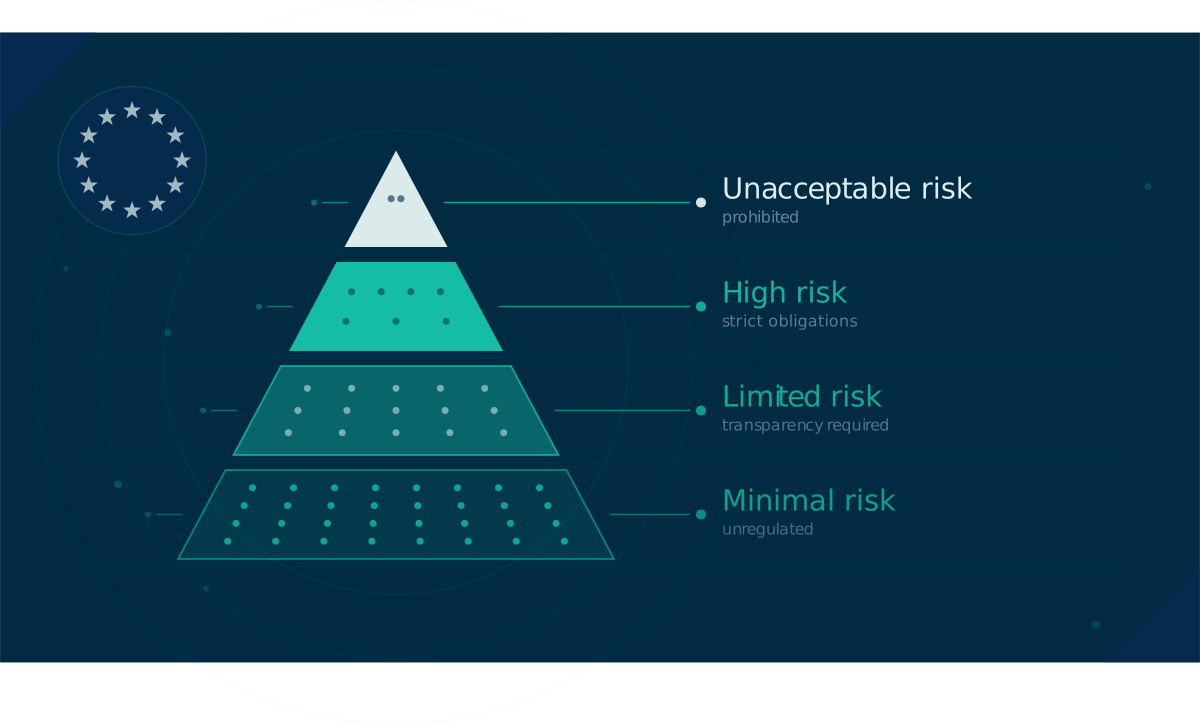
The law establishes four levels:
- Unacceptable risks: prohibited (behavioural manipulation, social scoring, real-time facial recognition in public spaces)
- High risk: substantial obligations (education, employment, justice, critical infrastructure)
- Specific risk: transparency required (chatbots, deepfakes)
- Minimal risk: unregulated (spam filters, AI in video games)
Complex value chains
Responsibilities extend throughout the entire chain: providers, deployers, importers, distributors and authorised representatives are all subject to AI Act obligations.
Business applications (ERP, CRM, HRIS)
The AI Act applies as soon as an ERP, CRM or HRIS embeds a chatbot, natural language transactions or content generation, whatever productivity gain those features are meant to deliver.
Key requirements for publishers:
- Inform users of AI interactions
- Mark generated synthetic content
- Comply with personal data protection rules
Governance
The European Commission will oversee harmonisation while national regulators will enforce the provisions. Fines follow three tiers (Article 99): up to €35M or 7% of global turnover for prohibited practices, €15M or 3% for other breaches, €7.5M or 1% for supplying incorrect information to authorities, with the cap reduced to the more favourable amount for SMEs.
What to do now
- Progressively familiarise yourself with the law and identify the articles applicable to your situation
- Assess the obligations applicable to your current and in-development AI systems
- Put compliance measures in place before the deadlines
These measures join the sovereignty requirements your customers already formulate: the Sovereign AI page details what a publisher must satisfy and prove.
Dura lex, sed lex: the law is harsh, but it is the law. With a ceiling of €35M or 7% of global turnover and general application landing on 2 August 2026, better to anticipate than to be caught unprepared.
The AI Act imposes a legal framework that publishers need to anticipate from the design stage. Beyond compliance, the underlying ethical questions deserve deeper consideration.
Bring AI into your software with Agora Software.
Let's talk