
Conversational access to business software: criteria
Context and evolution
ChatGPT’s public release in December 2022 put the idea of using natural language for complex searches back in the spotlight. Business software interfaces are going through a real tipping point, with three generations of interaction following one another:
- The Web, a 1990s development (the internet, JavaScript, XML).
- Mobile apps, which arrived with iPhones and their app stores (2007).
- Conversational access, which lets users state their request directly, in plain language.
For occasional use or frontline roles, conversation remains the most natural access point. It improves user experience, increases adoption, reduces the load on customer service, and sets the publisher apart in its market.
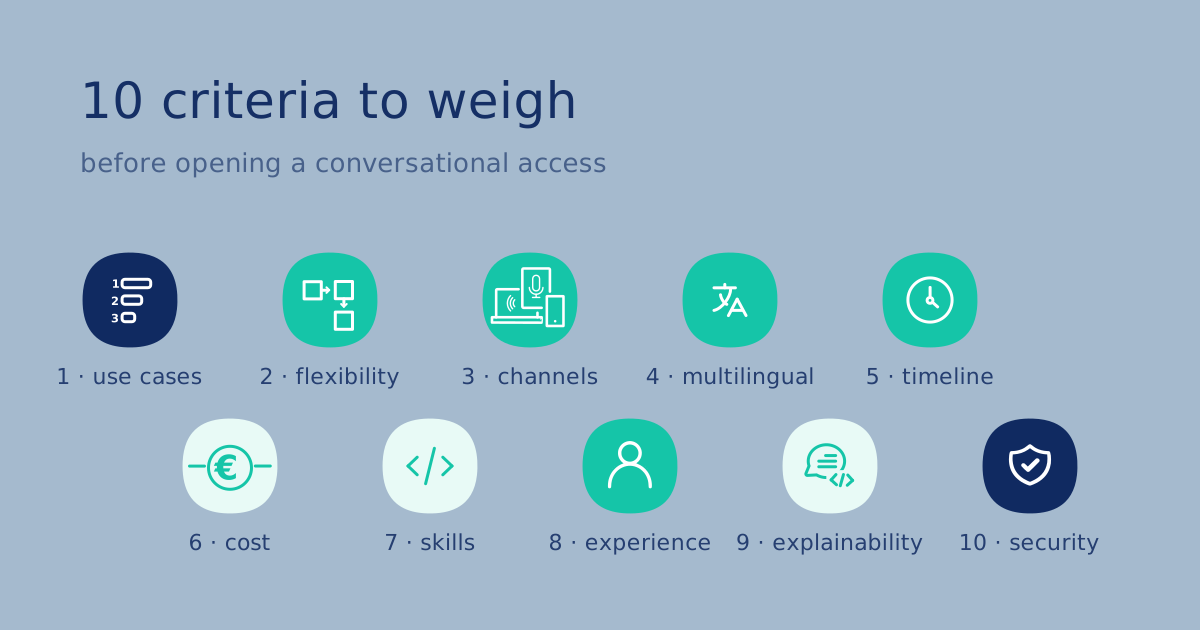
The 10 essential criteria
1. Use cases
Identify the functions that don’t need a complex graphical interface. On a full product (HRIS, ERP, finance), a handful of use cases is usually enough to justify a conversational interface: no need to cover everything from day one.
2. Flexibility
The implementation needs to keep up with future changes without excessive effort: business jargon, proper nouns, authentication, every new use case brings its own complexity.
3. Access channels
Being present on MS Teams, Slack, WhatsApp, mobile apps, even voice, maximises reach while keeping a consistent experience from one channel to the next.
4. Multilingual support
Being able to offer conversational access to the entire customer base at once, and add a new language without starting from scratch.
5. Rollout timeline
Without sharp natural language processing skills already in place, quick results are rare. On the projects we support, expect 6 to 24 months for a rollout across the whole product, depending on the number of use cases and the complexity of the integration.
6. Cost
- Design and development: on projects we’ve observed with publisher clients, from €60,000 for a targeted use case to €600,000 for a rollout across the entire product.
- Operations: the cost of NLP and generative AI tooling.
- Maintenance: a line item in its own right, not an afterthought in the budget.
7. Available skills
Balancing corrective maintenance against innovation, focusing effort on the core business and on the quality users actually experience.
8. User experience
The criteria worth watching: how well requests are interpreted, tolerance for typos, relevance of the answers, handling of poorly phrased requests, help for the user, freedom from hallucinations, speed of exchange.
9. Explainability
Natural language processing isn’t magic, and it can stay opaque. Bias, hallucinations, false information: these risks are real, and only a solid grasp of the technology and the data behind it delivers the transparency needed to keep them in check.
10. Security, privacy, sovereignty
Business applications often handle confidential, sometimes personal, data. An architecture built for security and privacy from the start isn’t optional. It’s also the criterion publishers underestimate most, until a customer’s security team asks the questions that matter: where the data is hosted, whether a non-EU subcontractor can access it, and how long exchanges are retained once they leave the interface.
Conclusion
Technology now puts conversational interfaces within reach of every business software publisher. But between a 6-to-24-month timeline and a budget of €60,000 to €600,000 depending on scope, this isn’t a trivial undertaking: it demands care and attention, because it quickly becomes a major point of contact with customers.
These 10 criteria give you a solid framework to evaluate your conversational project. To go further in the preparation, a complementary checklist helps structure the key integration decisions.
Bring AI into your software with Agora Software.
Let's talk