
Software publishers: simplify your users' journeys
What is the digital workplace?
Collaborative tools and social networks have multiplied within organisations without always considering user experience. These applications partially recreate physical exchanges in what is called the “digital workplace”.
The Digital Workplace is a work environment similar to a physical office or meeting room, but in a digital environment. It must be flexible enough to adapt to various professional and personal organisations (including remote work).
It concerns all employees, even those without screens or working on the go. Communication between users, applications, data and the organisation forms the heart of the concept, aiming to unite energies around organisational projects.
The trouble is that this workplace has grown more complex faster than it has gotten simpler: according to a Harvard Business Review study tracking 137 employees across three Fortune 500 companies, workers toggle between applications and websites roughly 1,200 times a day, adding up to nearly 4 hours a week just re-orienting after each switch.
Putting people at the heart of the digital workplace by speaking their language
Humans do not communicate in HTML or REST APIs. We use natural language to think, learn and exchange. Using natural language is a key to an effective and accessible workplace, facilitating adoption.
Although not all actions can be simply verbalised, significant progress is accessible for most requests and exchanges, applicable to both colleagues and digital solutions.
Software publishers: simplify your users’ lives
Your solution’s users work within a digital workplace (MS Teams, for example), organised around their projects and interests. Leaving that environment to open another application demands effort: finding the link, logging in, relearning the interface.
It will be more natural and faster for users to treat the application as a direct contact, sending messages in natural language from their preferred workspace.
Concretely, from within Teams, an employee can type “how many vacation days do I have left?” to their HRIS agent without opening the application or remembering where that information lives in the menu; the same logic applies to chasing an ERP invoice or running a payroll simulation, without switching screens.
Essential qualities for a good natural-language digital experience
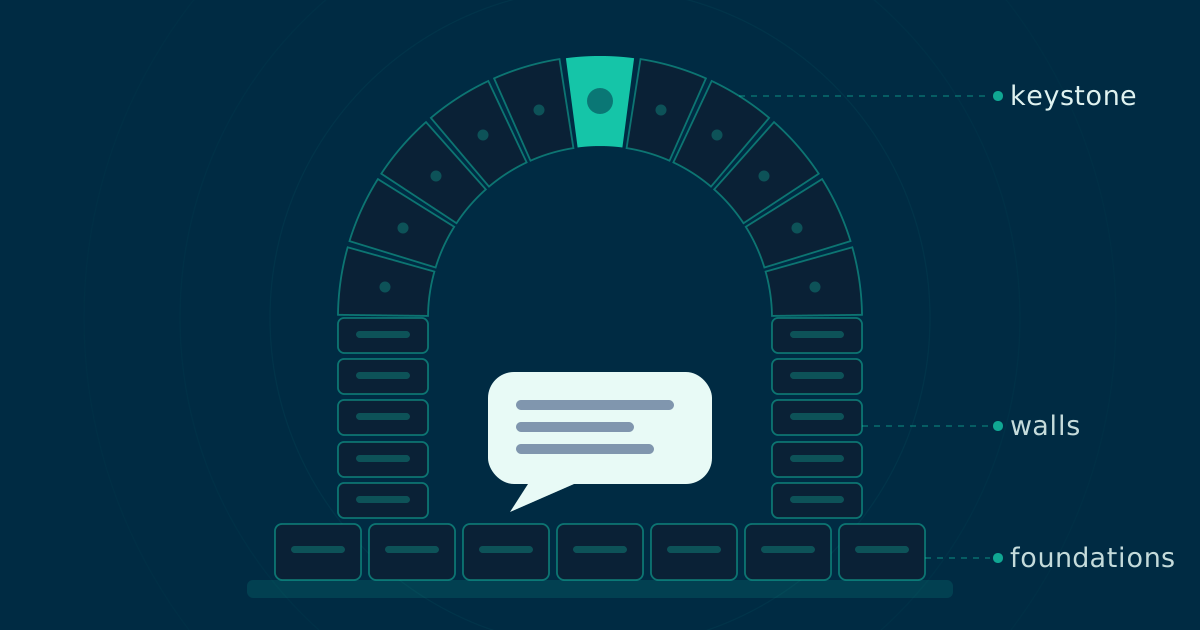
1. The foundations: NLP (Natural Language Processing)
Accuracy: Generalist NLP performance is impressive in personal contexts but falls short professionally. Other techniques are needed to reach the required precision.
Omnichannel: The same requests must be processed regardless of the channel (collaborative apps, social networks, SMS).
Multilingual: Organisations with international workforces must offer the same service in multiple languages.
2. The walls: integration with supported applications
NLP integration must ensure:
- Access control: authentication, permissions, legal compliance (distinct from infrastructure security, covered in the next point)
- Precision in understanding requests
- Clear responsibility boundaries between the business application and the NLP layer
3. The keystone: security, privacy and resilience
- Full communication encryption and rigorous key management
- No personal data retention, GDPR compliance
- Multiple hosting centres with automatic failover
Agora Software’s technologies
Agora Software strengthens the link between business applications and their users by offering:
- Integrated access from the digital workplace
- Direct business transactions
- Automatic responses to recurring questions
- Relevant notifications and information
Benefits for publishers:
- Simplify users’ lives
- Retain customers and employees
- Build brand and employer brand
- Relieve the back office
Natural language is the most direct lever for simplifying users' lives in the digital workplace. Agora Software builds this capability into business applications for publishers who want to make a difference.
Bring AI into your software with Agora Software.
Let's talk